
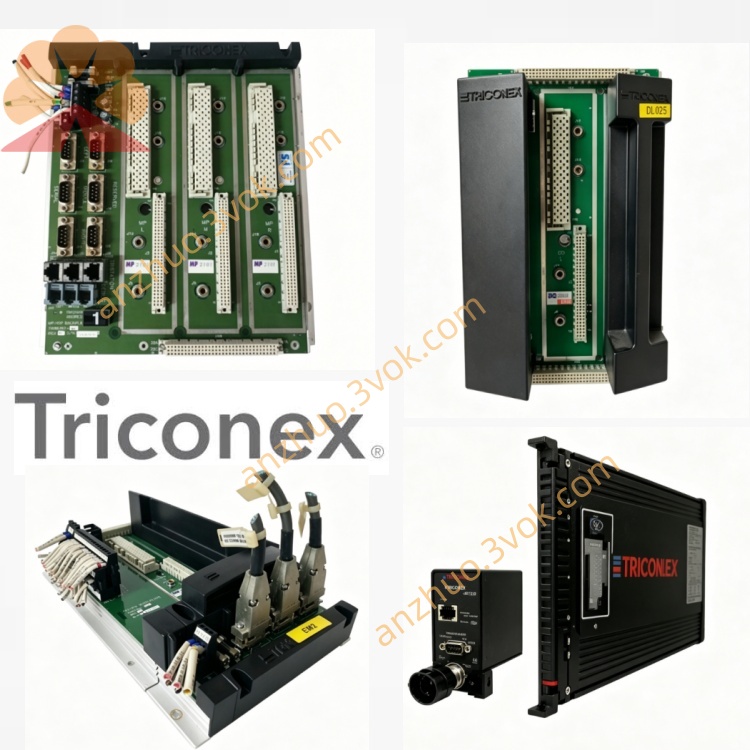
TRICONEX PI3381 third-generation TMR triple-modular
Description
1. Product Overview
2. Model Coding Definition
TRICONEX: Brand identifier for Tricon TMR safety control hardware
PI: Process Interface, representing new high-performance I/O series for modern Tricon platforms
3381: Hardware classification code, standing for 6-channel isolated differential pulse acquisition board
No suffix: Standard version for ordinary indoor control cabinets
-E: English firmware version for overseas projects
-IS: Intrinsically safe matched version, works with safety barriers for hazardous area cabinets
-HT: High-temperature enhanced variant with maximum operating temperature up to 70°C, suitable for high-temperature turbine islands and furnace-side cabinets
3. Core Electrical Specifications
Power supply: 24VDC from rack backplane, power consumption ≤7.5W, allowable voltage range 20~30VDC
Channels: 6 fully differential, channel-isolated pulse inputs
Supported signal types: Sine wave magnetic pickup, open collector, NPN/PNP active pulse
Frequency range: 0.5Hz ~ 32,000Hz
Minimum differential signal amplitude: 500mVpp (2~32kHz); 1Vpp (0.5~2Hz weak low-frequency signals)
Max transient withstand voltage per channel: ±33VDC
Channel isolation: 2000VAC isolation between internal TMR circuit and field side
Configurable debounce filter: 0.05ms ~ 20ms adjustable per channel
Built-in calculation functions: Real-time frequency, RPM conversion, pulse totalizer, customizable flow weight factor
Full-module scan cycle: ≤18ms, 1ms timestamp precision for SOE event recording
Independent overvoltage protection for each channel; single-channel open/short circuit fault only locks the corresponding channel without affecting other measurement loops
No built-in field sensor power; external 24VDC power is required for active transmitters via matched FTA terminal assemblies
4. Safety & Reliability Performance
Safety certification: IEC 61508 SIL 3, IEC 61511, TUV, UL, CE, ATEX, IECEx certified
TMR architecture: Three synchronous counting circuits execute hardware 2oo3 voting to eliminate measurement deviation caused by single-circuit failure or electromagnetic interference
MTTFS: 330,000 hours; MTTR <10 minutes supported by hot-swap function
Single fault tolerance: Partial channel faults or damage to one redundant channel will not cause full-module measurement failure
Latched non-volatile fault storage for safety audit and post-accident root cause analysis
5. Environmental & Mechanical Parameters
Standard operating temperature: -40°C ~ +65°C; -HT version up to +70°C
Storage temperature: -40°C ~ +85°C
Humidity: 5% ~ 95% non-condensing, IP20 cabinet protection rating
Passes full EMC tests: ESD, radiated RF, surge, fast transient burst interference
Single-slot horizontal installation in Tricon I/O rack, no forced cooling required under full load
Reinforced anti-vibration design for onshore petrochemical plants, thermal power turbine islands and offshore platforms
6. Hardware Interfaces
Rear interface: Proprietary triple isolated TriBus backplane connector, responsible for redundant power intake, bidirectional data exchange with three main processors and fault code upload
Front panel indicators: Global PASS running light, global FAULT fault alarm light, independent PULSE activity light and LOOP wiring fault light for each of the 6 channels
Field wiring: Matched dedicated FTA terminal base with shield grounding terminals per channel, supporting double-shielded twisted-pair industrial cables
7. Key Functions
Triple redundant high-bandwidth differential pulse counting
Three redundant circuits synchronously sample pulse signals up to 32kHz. Valid frequency, RPM and total pulse data are output after 2oo3 voting. Full differential isolation suppresses ground loop noise and long-cable signal attenuation.
Per-channel full-loop continuous diagnostics
Automatically detect three typical faults: field wire open circuit, short circuit to power/ground, and sensor disconnection. Fault codes with timestamps are uploaded to HMI and TriStation 1131 software.
Non-stop online hot-swap
The rack’s triple redundant bus maintains complete safety interlock logic when replacing a faulty PI3381 without rack power-off. The main processor automatically synchronizes all channel configurations to the spare module within 30 seconds after insertion.
Multi-stage configurable filtering and multi-mode counting
Adjustable digital debounce filters suppress field noise. Three optional counting modes: instantaneous speed measurement, flow totalizer accumulation, bidirectional encoder rotation discrimination. Optimized low-frequency weak signal compensation unavailable on legacy 3381.
Visual on-site channel status indication
Independent pulse activity LEDs allow field maintenance staff to quickly locate broken probes or loose wiring without logging into the control system.
8. Typical Application Scenarios
Large thermal power plant steam turbine SIL 3 overspeed protection
Petrochemical centrifugal compressor safety monitoring systems
Long-distance natural gas pipeline flow safety measurement
Offshore oil & gas platform rotating machinery fire & gas pre-alarm
Coal chemical furnace fan and compressor centralized speed monitoring
Fine chemical reactor agitator stall/overspeed interlock control
9. Installation & Maintenance Notes
Compatibility restriction: PI3381 only works with Tricon firmware V11 and above; cannot be installed on legacy racks running V9/V10 or older systems that support only 3381.
Wiring requirement: Double-shielded twisted cables with single-point grounding at cabinet ground bar; multi-point grounding on field sensor side is forbidden to avoid ground loop drift.
Hazardous area deployment: Match certified safety barriers with -IS version for Class I explosive cabinets.
Inspection cycle: Annual full accuracy calibration for standard control rooms; shorten to 6 months for offshore, coastal salt-fog and high-temperature turbine areas.
Fault replacement procedure: Hot-swap is allowed during normal stable operation; full rack shutdown maintenance must be arranged during unit startup, shutdown or emergency events.
Prohibited operations: Unauthorized disassembly, firmware flashing or hardware modification will invalidate all SIL safety certifications. Do not apply input voltage exceeding ±33Vpp to pulse terminals for long-term operation.
Get a Quote