
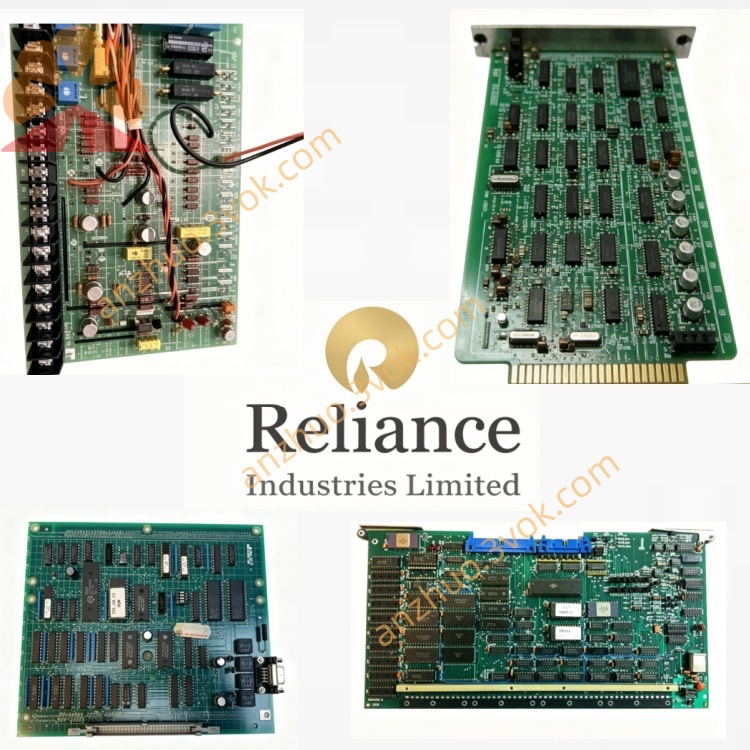
Reliance Electric 0-54200-3 (54200-3) High‑Speed Driver Board
Description
Product Introduction
Model Interpretation
Technical Parameters
Function: High‑speed SCR gate drive signal generation and pulse amplification.
Compatibility: Designed for Reliance Min‑Pak, Super‑Pak, and related high‑performance DC drive systems.
Power: Operates from the drive’s internal ±15 VDC control power supply.
Components: Integrates high‑speed transistors, pulse transformers, precision resistors, and capacitors.
Adjustments: Equipped with potentiometers for calibrating gate pulse width and timing delay.
Protection: Features onboard fuses, surge suppression, and short‑circuit protection.
Environment: Industrial grade; operating temperature -20°C to +60°C, non‑condensing humidity 5%–95%.
Construction: Through‑hole PCB with edge connectors; front edge has two extractor clips for easy rack installation/removal.
Dimensions: Approximately 457 mm × 305 mm × 25 mm; weight approx. 0.7 kg.
Interface and Communication Configuration
Power Interface: Connects to internal DC power rails via dedicated edge connectors.
Signal Interface: Multi‑pin headers receive speed reference, current feedback, and enable signals from the main control board.
Output Interface: Sends isolated, high‑speed gate pulses directly to SCR power modules.
Communication: Hardware‑only control board with no network ports; all signals are hardwired within the drive cabinet.
Core Functions
Generates high‑speed, precision‑timed SCR gate pulses for accurate DC output voltage/current regulation.
Delivers fast response to dynamic load changes, stabilizing motor speed and torque.
Adjusts gate pulse parameters via onboard potentiometers for optimal drive performance.
Provides overcurrent and short‑circuit protection by monitoring and limiting gate signals.
Interfaces with the main drive control board to coordinate high‑speed control loops.
Application Scenarios
Legacy DC Drive Maintenance: Replacement part for aging Reliance Min‑Pak/Super‑Pak DC drives in industrial facilities.
High‑Performance Motor Control: Used in systems requiring fast, precise DC motor control, such as extruders, winders, paper machines, and cranes.
Retrofit Projects: Cost‑effective repair/upgrade for older production lines where full drive replacement is uneconomical.
Operation and Maintenance Instructions
Safety: Disconnect all power and discharge capacitors fully before handling the board.
Installation: Align with chassis slots, seat edge connectors firmly, and secure mounting screws; use extractor clips for easy handling.
Calibration: During commissioning, adjust potentiometers for gate pulse width and timing delay per drive manual and motor nameplate data.
Maintenance: Keep the board clean and dry; inspect connectors for corrosion or loose wires quarterly.
Troubleshooting: If high‑speed instability or SCR misfiring occurs, check for damaged components or burnt traces; replace the board if faults are found.
Get a Quote